 GEM Foodtech
Home / Process lines / Cocoa
Cocoa processing
Cocoa bean cleaning, roasting, winnowing, grinding and powder processing — cocoa nibs, liquor, butter, natural and alkalised powder
The commercial reality
Cocoa is a separation business. One tonne of beans splits into roughly 400 kg of cocoa butter and 420 kg of cocoa powder, and the two sell at very different prices. The roaster sets the flavour, the winnower protects your yield and the press decides how each tonne divides between butter and powder. Get those three right and the rest of the line follows.
Process flow diagram
Generated for the standard configuration. Yours is redrawn to your product mix, capacity and site.
Process chart
Every stage with the equipment that performs it, the operating parameter and the control point that decides quality.
| # | Stage | Equipment | Parameter | Control point |
|---|---|---|---|---|
| 01 | Bean cleaning | Pre-cleaner and destoner | Vibrating sieve, destoner, magnet, aspiration | Stones, metal, jute fibre and dust removed |
| 02 | Roasting | Continuous or batch roaster | 120–140 °C, 15–35 min, to about 2% moisture | Flavour development, microbial kill |
| 03 | Cracking and winnowing | Cracker and winnower | Impact cracking, size grading, air separation | Shell left in nibs kept below spec |
| 04 | Alkalising, optional | Alkalising reactor | Nibs treated with alkali solution, then dried | Colour and pH to customer grade |
| 05 | Liquor grinding | Nib grinder and ball mill | Two-stage grinding to fine liquor | Fineness, typically 99% below 75 µm |
| 06 | Pressing | Hydraulic cocoa press | Warm liquor pressed in pots, butter filtered | Residual fat in cake, 10–12% or 20–22% |
| 07 | Cake breaking | Cake breaker | Press cake broken to kibble | Even feed size for the powder mill |
| 08 | Powder milling | Powder mill and classifier | Pulverised with cooled conveying air | Fineness without melting the fat |
| 09 | Cooling and sieving | Powder cooler and sifter | Fat crystallised in stable form, 75 µm sieve | No lumps, no grey bloom in the bag |
| 10 | Packing | Filling, sealing and packing line | 25 kg powder bags, butter in lined cartons | Fill weight, metal detection, seal |
Mass balance
Basis of 1,000 kg of raw material. Change the tonnage below and the whole table rescales.
| Stage | Output, kg/h | Yield | Loss, kg/h | Where the loss goes |
|---|---|---|---|---|
| Cocoa beans received | 1,000 | 100% | 0 | — |
| After cleaning | 985 | 98.5% | 15 | Stones, dust, fibre and flat beans |
| Roasted beans | 935 | 93.5% | 50 | Moisture and volatiles driven off |
| Nibs after winnowing | 815 | 81.5% | 120 | Shell and germ, sold for feed, mulch or fuel |
| Cocoa liquor | 810 | 81% | 5 | Grinding loss |
| Press cake at 11% fat | 420 | 42% | 390 | Cocoa butter — the second product, not a loss |
| Cocoa powder, sieved | 415 | 41.5% | 5 | Milling dust, collected and returned |
By-products: Cocoa butter (about 390 kg per tonne of beans) filtered and packed as a product in its own right; shell sold as animal feed, garden mulch or boiler fuel.
Equipment schedule
Core machines for this line. Conveying, liquor and butter tanks, dust collection and utilities are added to suit the layout.
| Equipment | Category | Function |
|---|---|---|
| Pre-cleaner and destoner | Preparation | Removes stones, metal, fibre and dust before anything touches the roaster. |
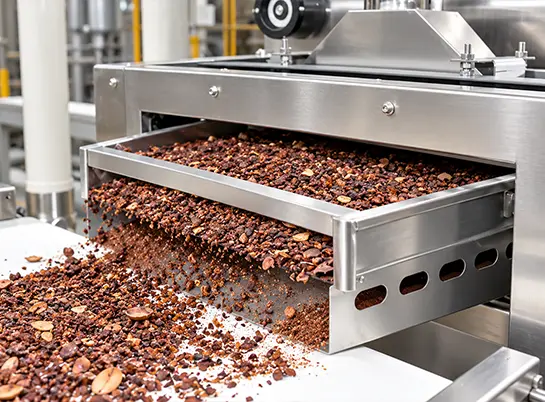
| Continuous or batch roaster | Thermal | Develops flavour and loosens the shell; temperature profile is the recipe. |
| Cracker and winnower | Separation | Cracks beans and separates shell by air; every point of nib lost to shell is lost margin. |
| Alkalising reactor | Thermal | Darkens colour and lifts pH for Dutch-process powder, then dries the nibs. |
| Nib grinder and ball mill | Separation | Turns nibs into smooth cocoa liquor in two stages. |
| Hydraulic cocoa press | Separation | Separates liquor into cocoa butter and press cake. |
| Cake breaker | Preparation | Breaks press cake into uniform kibble for milling. |
| Powder mill and classifier | Separation | Mills kibble to fine powder with cooled air so the fat does not melt. |
| Powder cooler and sifter | Separation | Stabilises the fat and grades the powder to size. |
| Filling, sealing and packing line | Packing | Weighing, filling, sealing, metal detection and case packing for powder and butter. |
Questions we get on this line
Natural or alkalised powder?
Natural powder is lighter, more acidic and suits baking with baking soda. Alkalised (Dutch process) powder is darker, milder and disperses better in drinks and dairy, which is where most industrial demand sits. An alkalising reactor before grinding lets one plant make both.
10–12% or 20–22% fat powder?
It depends how hard you press. Pressing to 10–12% residual fat recovers more cocoa butter; stopping at 20–22% gives a richer powder for premium drinks and confectionery. Set the press for the market you are selling into, because every point of fat moves value between butter and powder.
Whole bean roasting or nib roasting?
Whole bean roasting is simpler and loosens the shell for winnowing. Nib roasting gives a more even roast and suits alkalising before roasting, but needs a bean pre-treatment step to release the shell. Most mid-size plants start with whole bean roasting.
Want this line costed for your tonnage?
Send your bean origin, the products you want (liquor, butter, natural or alkalised powder) and the capacity you are targeting. You get a flow diagram, an equipment schedule and a budget number.